Medicare Marketing Strategy in 2026: The Complete Guide
CMS compliance rules, Scope of Appointment requirements, AEP timing, and the direct mail and lead economics behind Medicare marketing that actually stays compliant.


No marketing niche in the US operates under tighter federal oversight than Medicare. Every campaign, call script, and mailer touching a Medicare beneficiary falls under CMS (Centers for Medicare & Medicaid Services) marketing rules, and a compliance violation doesn’t just mean a warning — it can mean an agent losing their carrier appointment entirely, or a health plan facing sanctions. That reality shapes everything about how Medicare marketing actually works: the channels available, the timing, and even the specific words allowed in a piece of mail.
The economics have gotten harder too. Cost per Medicare lead has climbed sharply over the past year in many markets — from roughly $80 to $200 in some competitive metros — while shared leads sold to five or more agents at once keep degrading in quality and response rate. At the same time, CMS rule changes over the past several contract years have eliminated direct-to-consumer tactics that carriers and field marketing organizations relied on previously, meaning the agents and plans still growing their books are doing it through compliant, deliberate systems rather than simply outspending competitors during the Annual Enrollment Period.
This guide covers what actually matters: the compliance foundation every Medicare marketer has to build around, Scope of Appointment requirements and a genuinely useful recent rule change, the enrollment calendar that dictates timing, direct mail’s continued dominance with the 65-plus demographic, and how to measure the full funnel from lead to enrolled, retained beneficiary.
Medicare Marketing, by the Numbers
*Sources: Insurance Marketing Co. Medicare AEP Playbook, AgentTech CMS Marketing Guidelines, BSPKN Medicare Agent Marketing Guide, Mail Processing Associates, Data Decisions Group, SG360.
The Compliance Foundation: What’s Restricted and What Stays Open
During the Annual Enrollment Period specifically, CMS bars several tactics that would be routine in almost any other marketing category: cold-calling or door-knocking beneficiaries who haven’t requested contact, offering gifts worth more than roughly $15 per item, providing meals at a sales presentation, selling non-health products during a Medicare appointment, and marketing specific plans at an event advertised as educational.
What stays open matters just as much as what’s restricted. Print materials, email with a working opt-out, and inbound response all remain available — and critically, a beneficiary who calls an agent or fills out a form themselves is not considered unsolicited contact under CMS rules. That distinction is the foundation of nearly every compliant Medicare lead-generation strategy: build channels that let the beneficiary initiate contact (organic search, Google Business Profile, direct mail with a response mechanism) rather than channels that require reaching out to someone who hasn’t asked to be reached.
Educational events occupy a careful middle ground. Agents can hand out business cards, answer questions a beneficiary raises unprompted, and make Scope of Appointment forms available on-site — but cannot pitch a specific plan or take an application at an event billed as educational. If a sales conversation follows naturally, the transition has to be clearly announced, and attendees have to be free to leave before it begins.
CMS marketing rules don’t apply only during AEP. Requirements around call recording, Scope of Appointment, and the line between educational and sales events apply year-round — the organizations that build compliance into planning from the start reduce risk while keeping engagement consistent.
Scope of Appointment: The Rule That Governs Every Plan Presentation
A signed Scope of Appointment (SOA) form is required before any Medicare Advantage plan presentation, documenting exactly which products the beneficiary agreed to discuss. Every SOA has to be retained for a minimum of ten years — a retention requirement far longer than almost any other marketing compliance record.
One recent CMS rule change is worth knowing in detail because it directly changes what’s operationally possible: the requirement that an SOA be signed a full 48 hours in advance of an appointment has been removed. The current standard is simply that the SOA exists prior to the appointment — meaning same-day appointments that used to be turned away purely to satisfy a 48-hour clock are now permissible, provided the SOA itself is properly completed first. Agents and plans still running processes built around the old 48-hour rule are very likely turning away enrollable beneficiaries unnecessarily.
The Enrollment Calendar Dictates Everything
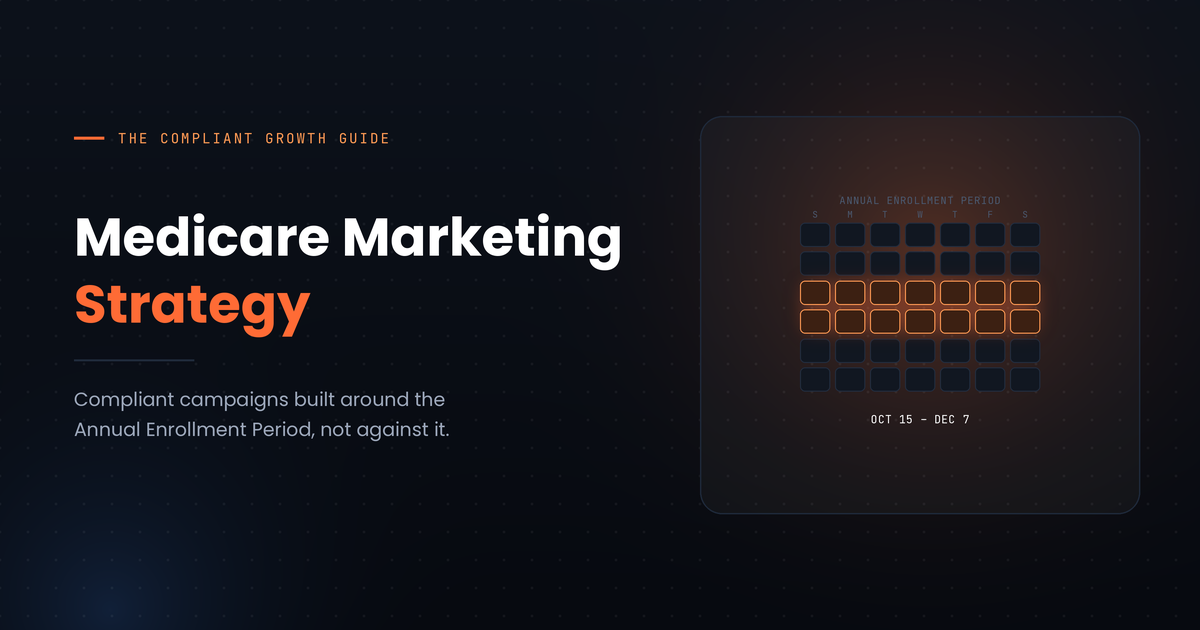
Two windows structure the entire Medicare marketing year. The Annual Enrollment Period, October 15 through December 7, is by far the largest and most scrutinized — CMS increases monitoring specifically during this window, and complaint-tracking thresholds are watched closely. The Open Enrollment Period, January 1 through March 31, offers a second, smaller window along with Special Enrollment Periods available to beneficiaries who qualify outside the standard calendar.
Marketing materials generally need carrier and CMS review well before AEP opens — typically 60 to 90 days ahead of the window, meaning materials intended for an October 15 launch need to be finalized by roughly mid-summer. Direct mail campaigns specifically should start planning even earlier: list acquisition and address-standardization processing in the earliest planning phase, design and compliance approval next, print production after that, with mail arriving in mailboxes before AEP begins. Deciding how to sequence and weight spend across AEP, OEP, and the SEP windows in between is fundamentally a channel-allocation question — the same discipline covered in our guide to marketing channel strategy, applied to a calendar where timing constraints are set by federal regulation rather than internal preference.
Get the Medicare Marketing Playbook
Join thousands of agents and health plan marketers getting our weekly playbook — CMS compliance updates, AEP timing frameworks, and lead-economics benchmarks — straight to your inbox.
Direct Mail Still Dominates the 65-Plus Demographic
Despite the broader shift toward digital marketing everywhere else, direct mail remains one of the most effective channels specifically for Medicare — the 65-plus demographic responds to physical mail at meaningfully higher rates than to digital channels, and a mailer provides the physical space needed to include CMS-required disclaimers and plan details that simply don’t fit cleanly into a digital ad format.
Effective Medicare direct mail targets narrowly rather than broadly: age (both beneficiaries aging into eligibility and current beneficiaries), geography down to the ZIP code or carrier route level, and income indicators that help differentiate a Medicare Supplement audience from a Medicare Advantage audience. List quality matters more than mail-piece design in this category — a beautifully designed mailer sent to the wrong list still underperforms a plain one sent to a precisely targeted list.
Lead Economics: Measuring the Full Funnel
The single biggest mistake in Medicare lead generation is optimizing for cost per lead in isolation. The number that actually matters is cost per enrolled beneficiary, measured across the full chain: cost per lead, contact rate, Scope of Appointment completion, enrollment, and ultimately cost per enrolled beneficiary. A $40 exclusive lead that actually enrolls beats a $9 shared lead that never gets reached — shared leads sold simultaneously to five or more agents create a response-time race that degrades contact rates for everyone competing for the same beneficiary.
Response speed during AEP specifically has a real, measurable payoff: a lead should reach a licensed agent within five minutes of arriving, receive a same-day second touch if the first attempt doesn’t connect, then four to six more attempts spread across the first week before dropping to a weekly cadence through the close of AEP on December 7. Budget realistically too — competitive metros generally require a minimum of $1,500–$3,000 monthly to generate meaningful digital lead volume, with AEP as the clear budget priority and lower-intensity Special Enrollment Period campaigns running year-round.
| Funnel stage | What to track |
|---|---|
| Cost per lead | Exclusive vs. shared — exclusive leads convert meaningfully better |
| Contact rate | Speed to first attempt is the single biggest lever here |
| Scope of Appointment completion | Now permissible same-day, not 48 hours in advance |
| Enrollment rate | The true measure of lead quality, not lead cost alone |
| Cost per enrolled beneficiary | The number that should drive every budget decision |
New Messaging Opportunities Worth Building Into Content
Part D’s ongoing redesign gives Medicare marketers genuinely new, beneficiary-relevant content angles beyond the standard plan-comparison messaging: a defined annual out-of-pocket cap in the low thousands of dollars, and the Medicare Prescription Payment Plan, which lets beneficiaries smooth prescription costs into predictable monthly payments rather than facing large costs at the pharmacy counter. Content built around these specific, concrete benefits tends to perform better than generic “compare your options” messaging, because it addresses a cost-anxiety beneficiaries can immediately relate to.
Digital and SMS Under Strict Consent Rules
Any text-based outreach to a Medicare beneficiary sits under some of the strictest consent requirements in all of marketing — TCPA rules combine with CMS’s own unsolicited-contact restrictions, meaning SMS can only reach beneficiaries who’ve clearly opted in, and every message needs a functioning opt-out. The compliant-opt-in and disclosure discipline covered in our guide to SMS marketing strategy applies directly here, though Medicare marketers need to layer CMS-specific requirements on top of standard TCPA compliance — a genuine opt-in that would be sufficient for a retail brand isn’t automatically sufficient for Medicare outreach.
Building Compliant Systems at Scale
Medicare shares its core structural challenge with other heavily regulated, trust-dependent insurance categories — speed-to-lead discipline, compliance review built into every piece of content, and a genuine referral and retention engine that reduces dependence on increasingly expensive purchased leads. Our broader guide to insurance marketing strategies covers many of the same principles in more general terms, and translates directly into a Medicare-specific compliance layer.
Running all of this simultaneously — CMS material review cycles, SOA documentation and retention, direct mail planning against a fixed federal calendar, lead-funnel measurement, and content built around a redesigned benefit structure — is a genuine operational lift for an agency, FMO, or health plan marketing team. For organizations without the internal capacity to run this as one coordinated, compliant system, our overview of digital marketing strategy consulting services in USA markets is a useful starting point for evaluating outside support built for exactly this kind of regulated, high-stakes execution.
Mistakes That Cost Agents and Plans
- Treating AEP as the only window that matters, when CMS rules and beneficiary need apply year-round
- Still enforcing the outdated 48-hour Scope of Appointment rule and turning away same-day appointments
- Optimizing for cost per lead instead of cost per enrolled, retained beneficiary
- Relying on shared leads sold to five or more agents simultaneously
- Slow lead response during AEP, when speed within the first five minutes has outsized impact
- Creating custom marketing materials instead of using CMS-filed, plan-approved content
- Blurring the line between an educational event and a sales event without proper disclosure
- Applying standard TCPA opt-in practices without layering CMS-specific consent requirements on top
Final Thoughts
Medicare marketing rewards precision more than almost any other category — precision in compliance, precision in targeting, and precision in measuring what actually matters at the end of the funnel. The agents and plans growing their books right now aren’t the ones spending the most during AEP; they’re the ones who’ve built compliant systems that work year-round, track cost per enrolled beneficiary rather than cost per lead, and respond to a new lead within minutes rather than hours.
The regulatory environment will keep shifting — rule changes like the recent Scope of Appointment update show CMS actively adjusting requirements, sometimes in ways that create real new opportunity for agents paying attention. Building marketing systems flexible enough to absorb those changes, rather than rigid processes calcified around outdated rules, is itself a competitive advantage in a category where compliance errors carry real consequences.
Start with the fundamentals: confirm your current SOA process reflects the latest rule, build lead-response speed into your operational discipline, and measure the full funnel down to cost per enrolled beneficiary. Everything else — direct mail targeting, educational content, digital consent management — compounds on top of that foundation.
Frequently Asked Questions
Grow Compliantly, Not Just During AEP
Get a free growth audit from TwoFold USA — and a Medicare marketing system built around cost per enrolled beneficiary, not just lead volume.
Get Free Growth Audit