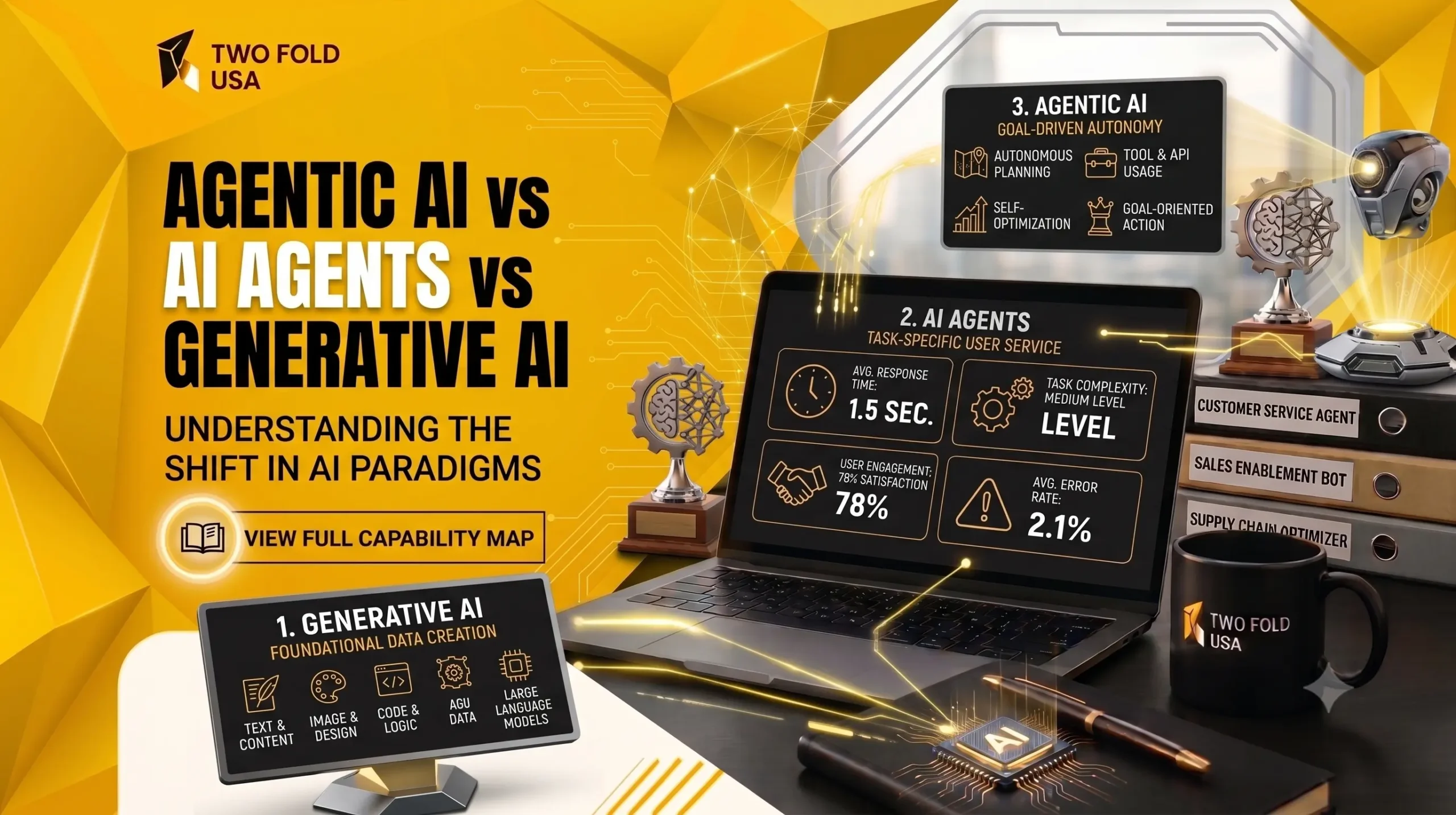
Agentic AI vs AI Agents vs Generative AI: The Clear 2026 Guide
Three terms, used interchangeably in every boardroom — and they mean very different things. Here’s a plain-English breakdown with real-life examples, comparison tables, and simple pointers.


“Generative AI,” “AI agents,” and “agentic AI” are three of the most overused — and most confused — terms in business right now. They get thrown around as if they’re synonyms, but they describe fundamentally different things, and mixing them up is expensive. When a company buys “an AI agent” and receives a polished chatbot, or invests in “agentic AI” expecting autonomy but still needs a human at every step, the gap is almost always a definitions problem, not a technology one.
The distinction matters more every quarter because the money is enormous. IDC projects worldwide spending on AI to exceed $632 billion by 2028, with the fastest growth in autonomous, multi-agent systems, and Gartner has found a majority of large enterprises now exploring autonomous agents — up sharply from a couple of years ago. Getting the vocabulary right is the first step to spending that budget well.
So let’s make it simple. This guide explains all three in plain English, gives real-life examples of each, and lays them out side by side in comparison tables. The key idea to hold onto from the start: these are not three competing technologies. They’re three layers of the same stack — each one building on the one before it.
Generative AI is the engine. An AI agent is a driver that can complete one trip. Agentic AI is the self-driving system that runs the whole fleet.
The 30-Second Version
If you read nothing else, read this:
- Generative AI creates content when you ask it to. It’s reactive — you prompt, it produces. (e.g. ChatGPT drafts an email.)
- An AI agent uses a generative model plus tools, memory, and planning to actually do a task for you, taking real actions. (e.g. it looks up your order and issues a refund.)
- Agentic AI is the broader system — often several agents orchestrated together — that pursues a goal or outcome autonomously, with minimal oversight. (e.g. it runs an entire refund-and-root-cause workflow end to end.)
In one line: generative AI makes, AI agents do, agentic AI owns the outcome. Now let’s unpack each one.
What Is Generative AI?
Generative AI is a model that produces new content — text, images, code, audio, video — in response to a prompt. It learned patterns from vast training data and uses them to generate something plausible and new. Crucially, it is reactive: it waits for you to ask, produces an output, and then stops. It doesn’t take actions in the world, remember much between requests, or pursue a goal on its own.
Real-life examples of generative AI:
- Asking ChatGPT or Claude to draft a client email, then reviewing and sending it yourself
- Using Midjourney or DALL·E to generate a hero image for a blog post
- GitHub Copilot suggesting a block of code as you type
- A marketer prompting an LLM to write five ad headline variations
The tell with generative AI is the human bookends. A person prompts it, and a person acts on what it produces. Take a delayed-shipment support scenario: generative AI can draft a warm, on-brand reply explaining the delay — but a human still has to look up the order, decide on compensation, and hit send. It’s a brilliant assistant with no hands.
What Is an AI Agent?
An AI agent wraps a generative model in the machinery it needs to actually complete a task: the ability to plan steps, use tools and APIs, remember context within the task, and take real actions. Give it a goal (“resolve this support ticket”), and it can carry out the multiple steps required — within guardrails you define — escalating to a human when it hits something it can’t safely handle.
An agent typically adds four things on top of the raw model:
- Planning — breaking a goal into steps
- Tool use — calling databases, CRMs, calendars, or other software
- Memory — holding context across the steps of the task
- A feedback loop — checking its own work and knowing when to escalate
Real-life examples of AI agents:
- A support agent that identifies the customer’s order, checks live tracking, issues compensation if policy allows, updates the system, and escalates edge cases to a human
- Doxy.me’s voice agent, which answers incoming telemedicine calls, triages routine questions, and hands complex ones to staff
- A coding agent (like Claude Code) that runs the test suite, fixes a failing test, and opens a pull request
- A scheduling agent that reads a request, checks calendars, and books the meeting
Back to the delayed shipment: an AI agent doesn’t just draft the reply — it pulls up the order, reads the tracking data, issues a refund within policy, updates the CRM, and notifies the customer. It has hands. But it’s still focused on this one task.
What Is Agentic AI?
Agentic AI is the broader paradigm: a system — often made up of several coordinated agents plus an orchestrator — that pursues a higher-level goal or outcome with minimal human oversight. Where a single agent completes a task, agentic AI owns an entire process, deciding which sub-tasks are needed, dispatching agents to handle them, remembering across the whole workflow, and adapting when things change.
Modern agentic systems usually combine several specialized components:
- A planner / orchestrator that splits a big goal into sub-goals and coordinates agents
- Multiple agents or models, each good at one thing (a coding model, a vision model, a research model)
- Persistent memory across the whole process, not just one task
- Monitoring and guardrails to catch errors and hold the system to policy
Real-life examples of agentic AI:
- JPMorgan Chase moving beyond its generative “LLM Suite” assistant into agentic workflows that execute complex, multi-step processes across the bank
- An automated month-end financial close that gathers transactional data, reconciles discrepancies, submits filings, and generates reports — flagging only exceptions
- A marketing ops system that researches a topic, drafts content, schedules it, monitors performance, and adjusts — orchestrating several agents
- A self-driving car: perception, planning, and control agents working together toward the goal “get there safely”
In the shipment example, agentic AI does everything the single agent did — and notices that delays from one supplier are spiking, opens a review, and adjusts the fulfilment process to prevent the next hundred complaints. It doesn’t just handle the ticket; it owns the outcome “keep customers happy.”
How the Three Stack Together
Each layer builds on the one inside it — they aren’t competitors.
The generative model is the core; an agent wraps it to act; agentic AI orchestrates agents to run entire workflows.
Side-by-Side: The Key Differences
Here’s the full comparison in one table. (Scroll sideways on mobile.)
| Dimension | Generative AI | AI Agents | Agentic AI |
|---|---|---|---|
| What it is | A model that creates content from a prompt | A single system that uses a model to complete a task by taking actions | An orchestrated system of one or more agents pursuing a goal autonomously |
| Question it answers | “Can you make me X?” | “Can you do this task for me?” | “Can you own this outcome?” |
| Autonomy | Low — waits for prompts | Medium — completes a task within guardrails | High — plans & acts across steps with little oversight |
| Takes real actions? | No — just produces output | Yes — within a defined task | Yes — across whole workflows |
| Memory & planning | Little / none (per prompt) | Task-level memory + tool use | Persistent memory, planning, feedback loops |
| Human role | Prompt & act on the output | Set the goal; approve edge cases | Set objectives & guardrails; monitor exceptions |
| Under the hood | LLM / diffusion model + prompt | Model + tools + memory + planning loop | Multiple agents/models + orchestrator + monitoring |
| Analogy | The engine | A driver on one trip | A self-driving fleet running itself |
| Real-life example | ChatGPT drafts a reply; Midjourney makes an image | Doxy.me’s voice agent handles a call end-to-end | JPMorgan’s multi-step agentic banking workflows |
| Best for | Content, drafts, ideation, code snippets | Automating one specific, repetitive task | Automating an entire multi-step process |
Cut Through the AI Noise
Join thousands of leaders getting our weekly, jargon-free breakdown of how real companies apply AI and automation to grow — straight to your inbox.
One Task, Three Approaches
The clearest way to feel the difference is to watch the same job — “a customer messages about a delayed order” — handled at each level. Notice how the work each one takes off your plate grows as you move right.
| Step in resolving the ticket | Generative AI | AI Agent | Agentic AI |
|---|---|---|---|
| Understands the message | ✔ | ✔ | ✔ |
| Drafts a warm, on-brand reply | ✔ (human sends) | ✔ | ✔ |
| Looks up the order & tracking | ✘ | ✔ | ✔ |
| Issues a refund within policy | ✘ | ✔ | ✔ |
| Updates the CRM & notifies the customer | ✘ | ✔ | ✔ |
| Spots a pattern of delays & fixes the root cause | ✘ | ✘ | ✔ |
| What the human does | Prompts & sends | Approves edge cases | Sets policy, monitors |
How They Relate (They Don’t Compete)
The most important mental model is that these are layers, not rivals. Every AI agent has a generative model at its core doing the reasoning. Every agentic system is made of agents. You can’t “pick agentic AI instead of generative AI” any more than you can pick a car instead of an engine — the engine is inside the car.
- Generative AI is the reasoning core.
- Add tools, memory, and planning → you get an AI agent.
- Orchestrate multiple agents toward a goal → you get agentic AI.
This is why the terms blur in practice: modern foundation models increasingly include tool use and multi-step reasoning natively, so the jump from “generative” to “agentic” is becoming a matter of configuration rather than a whole new architecture.
Which One Does Your Business Actually Need?
You don’t need the most autonomous option — you need the one that matches the job. A quick way to decide:
- Start with generative AI if you mostly need faster content, drafts, summaries, or code — and a human will review the output. Low cost, fast ROI, minimal infrastructure.
- Move to an AI agent when a specific, repetitive, multi-step task (support tickets, scheduling, data lookups) is eating real time and has clear rules. More engineering and testing, but big time savings.
- Invest in agentic AI when an entire process — not a single task — is worth automating end to end, and you have the data maturity and governance to oversee it. Highest investment, most transformative return.
A practical rule: match the tool to the shape of the problem. Content and ideation → generative. A repetitive task with clear rules → an agent. A whole workflow you want to run itself → agentic. And whatever the level, keep a human in the loop wherever the stakes are high.
Common Misconceptions to Avoid
- “Agentic AI replaces generative AI.” No — it’s built on top of it. Generative models are the engine inside agents.
- “ChatGPT is an AI agent.” Mostly it’s generative AI. It becomes agent-like only when wrapped with tools and allowed to take multi-step actions.
- “AI agents and agentic AI are the same thing.” An agent completes a task; agentic AI orchestrates agents to own an outcome. Related, not identical.
- “More autonomy is always better.” Full autonomy without oversight is rarely advisable — the best deployments define tight guardrails and keep humans on high-stakes calls.
- “It’s a technology choice.” It’s really an operating decision: scope, data, governance, and human oversight matter more than the model itself.
Final Thoughts
Strip away the buzzwords and the picture is simple. Generative AI creates. AI agents act on a task. Agentic AI orchestrates agents to own an outcome. They’re three layers of one increasingly capable stack — and most organizations are still on the first or second rung, which is completely fine. The goal isn’t to leap to the most autonomous option; it’s to match the layer to the problem.
Getting the vocabulary right protects your budget and your expectations. When you brief a vendor, ask which layer you’re actually buying, what actions it can take, and where the human stays in the loop. That single question prevents the most common (and most expensive) AI mistake of 2026: paying for one layer while expecting another.
Start where the value is clearest, measure honestly, keep humans on the high-stakes decisions, and climb the stack as the returns justify it. Used that way, all three — generative, agentic, and the agents in between — become tools that compound rather than confuse.
Frequently Asked Questions
Put the Right AI to Work
Get a free growth audit from TwoFold USA — and a practical plan for where generative, agent, or agentic AI can actually move your pipeline.
Get Free Growth Audit