B2B Marketing Campaign Strategies: The Complete Playbook for Pipeline Growth
Ten campaign strategies built for how B2B buyers actually decide today — self-directed research, buying committees, intent signals, and AI — plus the pipeline metrics that prove they worked.
The B2B campaign that worked three years ago will quietly underperform today — not because the tactics broke, but because the buyer changed. Purchase decisions now run through committees of many stakeholders, most of the evaluation happens before a vendor is ever contacted, and buyers increasingly form their shortlist using AI tools and peer reviews rather than a sales rep’s pitch. A campaign strategy that assumes a single decision-maker who wants to “talk to sales” is aiming at a target that has already moved.
That shift is why so much B2B marketing spend produces beautiful dashboards and very little pipeline. Teams keep optimizing for clicks, MQLs, and form fills — metrics that describe activity, not revenue — while the actual buying journey plays out in channels they can’t easily see. The winning campaigns are built around how decisions really get made now: multi-stakeholder, self-directed, signal-driven, and increasingly mediated by AI.
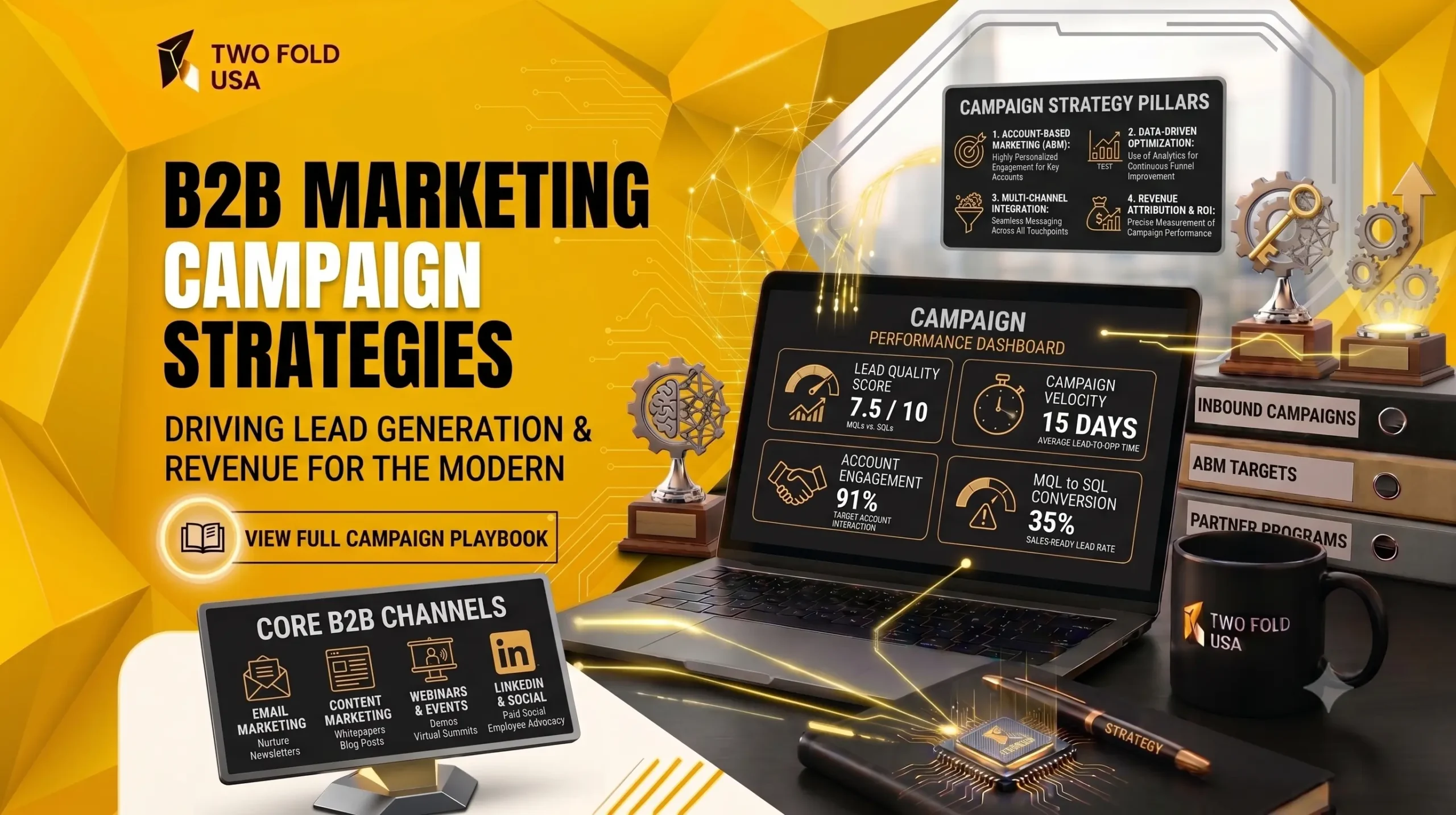
This playbook lays out ten campaign strategies that reflect that reality, from mapping the buying group and running tiered account-based programs to activating intent data, building for the self-educating buyer, earning visibility inside AI answers, and measuring what a CFO actually cares about. Each one is designed to move pipeline and revenue rather than vanity numbers.
Whether you sell software, industrial equipment, or professional services, the underlying principle is the same: modern B2B campaigns win by being relevant to the right accounts at the right moment, across every channel a buying committee touches — and by proving their impact in the language of pipeline. Use these as a menu, not a checklist; start where the leverage is highest for your business.
Why B2B Campaigns Look Different Now
Three structural changes should shape every campaign decision you make. First, buying is a committee sport: research consistently shows a typical B2B purchase now involves a buying group of roughly 5 to 16 people, each with different priorities. Second, buyers self-educate: an estimated 60–70% of the purchase journey happens independently, before anyone contacts sales, with prospects consulting search, AI assistants, and peer communities along the way. Third, attribution is broken in most orgs — around 90% of teams admit they can’t connect early-funnel activity to closed revenue, which is why so much budget flows to whatever looks busy.
Put together, these mean a campaign can no longer be a single message to a single lead. It has to reach a group, show up during self-directed research, and be measurable in pipeline terms. The strategies below all trace back to those three facts.
Modern B2B campaigns don’t chase more names in a spreadsheet. They earn deeper engagement with the right accounts, at the right moment, across every channel the buying committee touches.
What Changed About B2B Buying
*Directional figures from current B2B research. Sources: Improvado, Forrester, Dreamdata, and industry buyer-journey studies.
1. Start With a Tight ICP and Map the Buying Group
Every strong B2B campaign begins with ruthless targeting. Define your ideal customer profile narrowly — the firmographics, tech stack, and triggers that make an account genuinely winnable — then map the buying group inside it. For your top accounts, you should be able to name the roles: the champion who advocates internally, the economic buyer who owns the budget, the technical evaluator, and the end users who live with the decision daily.
This mapping is what makes everything downstream relevant. A campaign that speaks to a CFO’s ROI case and an end user’s workflow pain in the same account, with different content, is playing the game as it’s actually scored. A red flag that you’re skipping this step: you can’t name the buying-group members for your top twenty target accounts, and your “personalization” stops at a first-name merge tag.
2. Run Tiered Account-Based Campaigns — Not Spray-and-Pray
The most common ABM failure is targeting too many accounts. Account-based programs are expensive — they require dedicated content, sales alignment, and real personalization — so spreading them across hundreds of accounts dilutes everything into generic demand gen. The fix is a tiered model that matches effort to account value.
- Tier 1 — one-to-one: deep, custom campaigns and landing pages for a small set of strategic accounts
- Tier 2 — one-to-few: industry- or use-case-personalized campaigns for clusters of similar high-intent accounts
- Tier 3 — one-to-many: scalable, lightly-personalized programs that keep a wide net over future-intent buyers
One honest caveat: account-based marketing tends to underperform below roughly $50k in annual contract value, where the economics don’t justify the effort. Below that, weight your mix toward efficient demand generation instead.
The Tiered ABM Model
Match personalization and spend to account value.
*Illustrative account counts — set your own tiers by ACV and win probability.
3. Activate Intent Data and Predictive Scoring
The biggest advantage in modern B2B is timing — reaching an account while it’s already researching. Intent data (both third-party signals and your own first-party behavior) plus predictive account scoring let you spot which accounts are warming and prioritize them before your competitors do. The goal is to catch the “intent surge” and shorten the lag between a buyer showing interest and your team engaging.
Used well, this is transformative: teams that layer intent signals onto tightly-defined accounts routinely build meaningful pipeline from accounts they’d previously struggled to move. The discipline is to act on signals fast and route them to sales with context, not to hoard a dashboard of “intent” nobody follows up on.
4. Build for the Self-Educating Buyer
If most of the journey happens before contact, your campaigns must help buyers educate themselves rather than force a sales conversation. That means investing in buyer-enablement content and self-serve experiences: comparison guides, ROI calculators, interactive demos, and clear pricing or scoping content that lets a committee evaluate you without a gatekeeper.
This is also how you influence the stakeholders you never speak to. A well-built ROI calculator gives your champion the exact artifact they need to sell you internally to the economic buyer. Content that answers real evaluation questions — honestly and specifically — does more selling in the dark funnel than any gated whitepaper.
5. Earn Visibility Inside AI Search (AEO / GEO)
A growing share of B2B buyers now begin research with an AI assistant, asking for shortlists and comparisons before they ever open a traditional results page. If your content isn’t structured to be cited in those answers, you’re invisible at the exact moment the shortlist forms. This discipline — often called AEO or GEO — is quickly becoming a core campaign capability, not a nice-to-have.
Winning here looks different from classic SEO: it rewards clearly-structured, direct-answer content, specific and credible positioning, schema markup, and earned mentions in the trusted sources that language models cite. Build a plan to appear in AI answers the same way you built one for Google a decade ago.
Get More B2B Campaign Playbooks
Join thousands of B2B marketing leaders getting our weekly playbook — pipeline frameworks, ABM teardowns, and channel benchmarks — straight to your inbox.
6. Lead With Brand and Thought Leadership
Demand generation gets the credit, but brand is what makes demand efficient. The accounts that already recognize and trust you convert at a fraction of the cost of cold ones — which is why leading teams pair demand campaigns with consistent thought leadership, especially on LinkedIn, where a large and rising share of B2B ad budgets now flows. Executive and employee voices, sharing a genuine point of view, build the familiarity that shortens later sales cycles.
Employee advocacy amplifies this, but handle it with care: advocacy programs frequently collapse without clear governance. Give participants shared narratives, usage and disclosure standards, and light compliance guardrails so the program is sustainable rather than a one-quarter burst.
7. Orchestrate Across Channels, Not in Silos
A buying committee doesn’t experience your “email campaign” and your “LinkedIn campaign” as separate things — they experience your brand. The strongest programs coordinate messaging across email, social, paid, content, and direct sales outreach so an account hears a consistent story at each stage. This account-based experience (ABX) approach treats marketing, sales, and customer success as one motion around the account.
Practically, that means sequencing: intent signal triggers a relevant ad and a tailored email, which sets up a sales touch referencing the same theme, all pointing to the same self-serve asset. Coordination, not volume, is what makes every touch feel like it was meant for that account.
8. Use AI for Personalization and Automation — on Clean Data
AI has moved from experimental to essential in B2B campaigns. Its highest-value uses aren’t just generating content — they’re hyper-personalization, intent-based targeting, predicting when an account is most likely to engage, and sequencing the right message at the right stage. Used well, AI makes account-based programs both broader in reach and sharper in focus.
Two guardrails matter. First, AI on dirty data is a liability, not an asset — Forrester has warned that ungoverned AI on poor data creates serious enterprise risk, so clean your CRM and segmentation first. Second, keep humans in the loop: AI can surface trends and automate distribution, but it can’t read a boardroom or supply the strategic empathy and storytelling that actually move committees.
9. Align Sales and Marketing Around Pipeline
Most B2B campaign underperformance is really a misalignment problem. When marketing chases MQLs and sales chases quota with different definitions and dashboards, accounts fall through the cracks between them. A RevOps approach fixes the plumbing: shared account lists, shared definitions, and shared dashboards where both teams look at the same pipeline goals.
The simplest test of alignment is whether sales and marketing can sit in the same review and agree on which accounts are progressing and why. When intent signals, campaign engagement, and sales activity live in one view, hand-offs get faster and follow-up stops leaking the pipeline your campaigns worked to create.
10. Measure What a CFO Cares About
The final strategy governs all the others: change what you measure. Impressions, followers, raw traffic, and even MQLs describe motion, not money. Leading B2B teams have shifted to metrics that connect to revenue — marketing-influenced and marketing-sourced pipeline, pipeline velocity, brand-assisted deal size, and win rate — because these are the numbers that survive a conversation with finance.
This isn’t just reporting hygiene; it changes behavior. When a campaign is judged on pipeline influence rather than lead volume, teams naturally build for the committee, the dark funnel, and the long sales cycle instead of gaming a form-fill target. Measure impact, and the strategy follows.
Mistakes That Sink B2B Campaigns
Across the strategies above, the same avoidable errors show up again and again. Any one is worth fixing before you scale spend:
- Running account-based programs on too many accounts, until they’re just generic demand gen
- Optimizing for MQLs and form fills instead of pipeline and revenue
- Deploying AI on messy, ungoverned CRM data — amplifying errors at scale
- Personalization that stops at a merge tag with no account-specific insight
- Launching employee advocacy with no governance, so it collapses in a quarter
- Forcing sales conversations on buyers who want to self-educate first
- Treating channels as silos, so the committee gets a fragmented story
- No plan for showing up in AI-assistant answers during research
A Simple Way to Start
You don’t need to run all ten strategies at once. A practical sequence that works in real companies:
- First 30 days: clean CRM data and segmentation, agree on shared pipeline metrics with sales, and pick your Tier 1 accounts.
- Next 30 days: launch one tiered ABM pilot with intent data, and ship one self-serve asset (a calculator or interactive demo).
- Following 30 days: layer in orchestrated multi-channel sequencing and a thought-leadership cadence, and review by pipeline influence weekly.
Let the numbers — not opinions — decide what to scale. Deeper engagement with the right accounts beats more names every time.
Final Thoughts
B2B campaign strategy has quietly become a different discipline. The buyer is a committee, the journey is mostly invisible and self-directed, and the shortlist increasingly forms inside AI tools and peer conversations before a rep ever picks up the phone. Campaigns that still assume a single lead who wants to talk to sales are optimizing for a world that no longer exists.
The strategies in this playbook all point the same direction: be relevant to the right accounts, show up where the committee actually researches, coordinate every channel around a consistent story, and measure your work in pipeline rather than vanity metrics. Do that, and marketing stops being a cost center that reports on activity and becomes a growth engine that reports on revenue.
Start where your leverage is highest — usually tighter targeting, cleaner data, and better measurement — then build outward. The teams that win aren’t chasing every trend; they’re applying the few that matter to how their buyers actually decide, and holding every campaign accountable to the pipeline it creates.
Frequently Asked Questions
Build a Pipeline-First Campaign
Get a free growth audit from TwoFold USA — and a B2B campaign plan built around your accounts, your buying committee, and real pipeline.
Get Free Growth Audit