
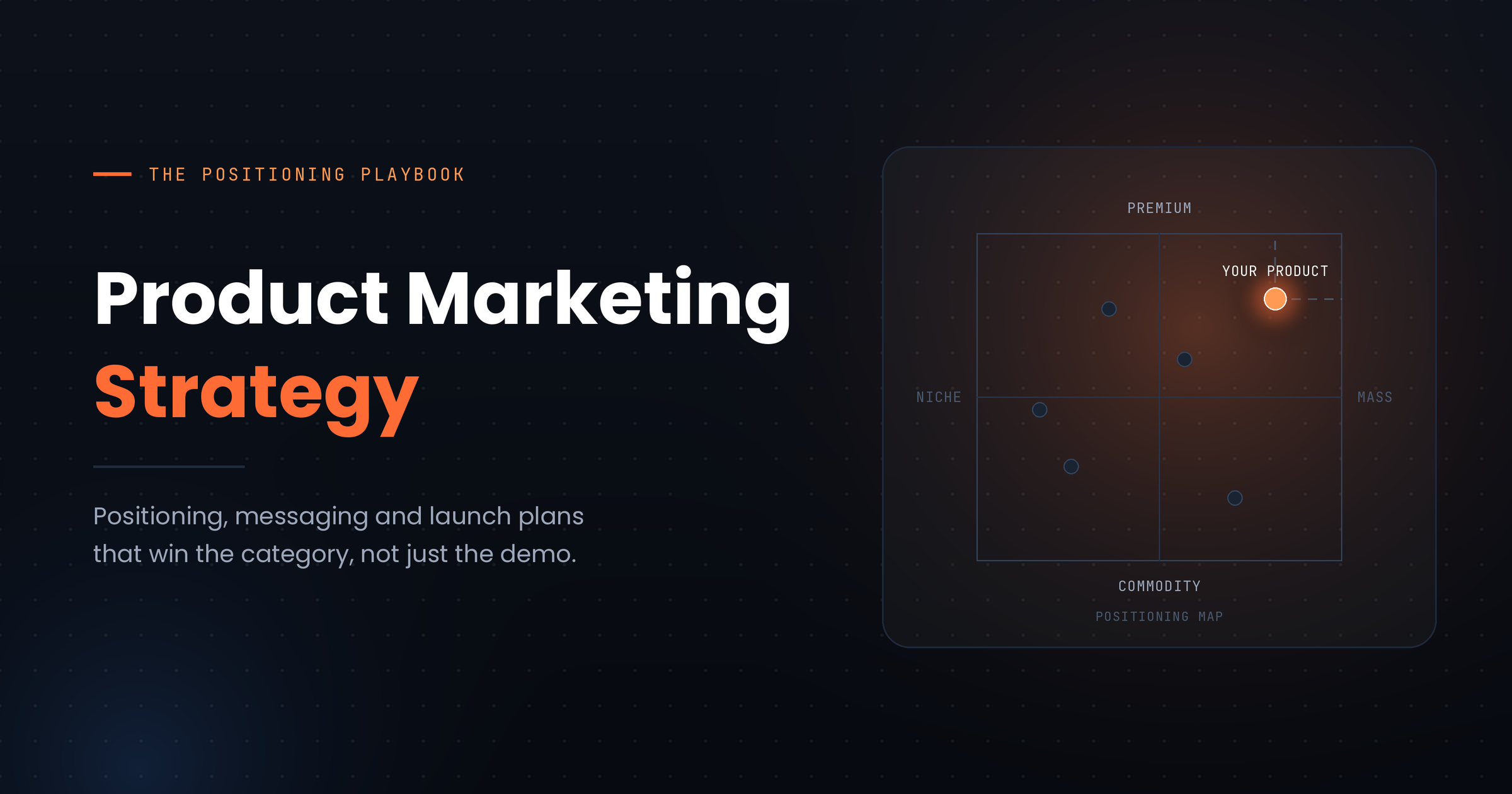
Product Marketing Strategy Secrets in 2026: What Top PMM Teams Do Differently
The launch tiering, win-loss, sales enablement, and positioning tactics that separate top-performing product marketing teams from everyone else — backed by current benchmark data.


Product marketing has quietly stopped being a support function. It’s now judged the way sales and demand gen are judged — on pipeline influence, win rate, and net revenue retention — and the teams that treat it that way are pulling away from the ones still measuring themselves on launch decks shipped. Nearly every product marketing team owns positioning and messaging, the highest-ownership responsibility of any PMM task, and the companies growing fastest share a common trait: sharp positioning, clear go-to-market process, and a PMM function that owns both rather than just documenting them.
But most of what separates top-performing teams from average ones isn’t visible from the outside. It’s not the launch deck template or the messaging framework — it’s a handful of operating disciplines that rarely make it into a “how to do product marketing” 101 post: how launches are tiered so resourcing doesn’t get diluted, how win-loss data actually gets used instead of filed away, and — the single biggest gap in the discipline right now — how content gets from a PMM’s laptop into an actual sales rep’s hands.
That last point deserves a number up front, because it reframes everything else in this article: across an 800-team benchmark study, the median share of sales-enablement assets that reach a rep within 30 days of a launch is just 22%. Batttlecards and internal training clear that bar; launch decks, customer stories, win-loss summaries, and one-pagers mostly don’t. Production has never been easier. Distribution is where the real strategy now lives.
This is a working list of the tactics that actually separate strong PMM operations from the rest — grounded in current benchmark data, not theory. Pick the ones that expose your biggest gap first.
Product Marketing, by the Numbers
*Sources: Product Marketing Alliance State of Product Marketing, Digital Applied’s PMM benchmark study (800+ teams), Clozd, Young Urban Project.
The Secrets: What Top PMM Teams Actually Do
-
Positioning is a revenue lever, not a slogan exercise
Treat positioning as four hard components — target customer, problem, solution, and competitive differentiator — not a punchy line for a landing page. Weak positioning stays a Google Doc; strong positioning shapes pricing, packaging, and every sales conversation downstream. It’s the single highest-leverage input into PMM effectiveness, which is exactly why 91% of teams claim ownership of it.
-
Consider “solutions marketing” over narrow feature marketing
The most sophisticated B2B teams are shifting language and structure away from marketing individual product features toward marketing complete solutions to a buyer’s problem. It’s a subtle change with real consequences — it pulls PMM into roadmap conversations earlier and produces messaging built around outcomes, not screenshots.
-
Tier your launches deliberately — and audit your tier discipline
Not every release deserves the same resourcing. A genuine Tier-1 launch means cross-functional resourcing, paid promotion, and a full enablement bundle — companies around $50M ARR average 2.4 of these a year, with top performers at 4.1. Fewer than two signals under-resourced launches; more than five is often “tier inflation,” where routine updates get dressed up as major launches to justify headcount. Both failure modes are common — audit yours honestly.
-
Treat distribution as the real constraint, not creation
This is the gap most teams miss. With a median of just 22% of enablement assets reaching a rep within 30 days, the bottleneck in most PMM operations isn’t writing more content — it’s getting the content that already exists into the hands of the people who need it, in the format they’ll actually use.
-
Measure content-influenced win rate, not just usage
Usage tells you an asset was opened. Content-influenced win rate — comparing outcomes on deals where an asset was used against deals where it wasn’t — tells you whether it changed anything. If usage is high but influenced win rate shows no lift, that’s a messaging problem, not a distribution problem, and it sends you back to positioning rather than to nagging reps.
-
Let AI draft, but keep a human on emotional resonance
AI-assisted first drafts for launch copy have gone from a novelty to the default, with adoption climbing roughly 51 points in two years. Use that speed — but the data analysis and the emotional storytelling are different jobs. AI handles the former well; the persuasive, human read on what will actually resonate with a buyer still belongs to the PMM.
-
Build a real win-loss program, not an occasional survey
Win-loss interviews are one of the fastest-growing uses of AI in the discipline right now precisely because they’re so underused manually. One frequently cited case study attributes a 10% increase in gross retention to a win-loss program built around product-adoption and roadmap decisions. The catch: CRM-logged competitor data is notoriously unreliable, with mis-tagging rates estimated near 65% — treat self-reported CRM fields as a lead to verify, not a fact to act on.
-
Plan for the pipeline decay curve, not just launch day
Launch-quarter pipeline lift averages around +38% but decays to roughly +12% by two quarters out — a pattern consistent across deal sizes and sectors. Top teams plan for that decay in advance: demand-gen overlays, partner co-marketing, and customer-story drops scheduled for the quarter after launch, not scrambled together when the lift fades.
-
Give sales fewer, sharper assets — not more of them
An estimated 65% of marketing content goes unused by sales, a figure that’s barely moved in a decade. The instinct to produce more collateral usually makes this worse. Formal enablement programs that curate deliberately, rather than flood reps with options, win roughly 49% of forecasted deals versus 42.5% for teams without a program — a gap that widens further for the strongest programs.
-
Talk to your buyer before you write a single word of messaging
One in five product marketers still doesn’t engage the target audience during launch planning — the single most expensive mistake in the discipline. Messaging built without customer input is guessing out loud, however confident it sounds in the room. A handful of real customer interviews before the positioning doc is drafted beats a dozen internal brainstorm sessions after.
-
Treat pricing and packaging as a positioning decision
The pricing model you choose signals what kind of product you are and who it’s for, as much as any tagline does. Usage-based, seat-based, and flat-fee pricing each tell a buyer a different story about value — pricing decisions belong in the same strategic conversation as messaging, not bolted on afterward by finance alone.
-
Own retention metrics, not just launch splash
The PMM scorecard has expanded well beyond launch KPIs. Pipeline influence, win rate by segment, feature adoption, sales cycle length, and net revenue retention are now the metrics that matter — and the strongest PMMs don’t just report these numbers, they take responsibility for moving them.
-
Build zero-party data relationships through community
As privacy regulation tightens and third-party data gets harder to rely on, the PMM teams staying ahead are building direct relationships — customer communities and advisory boards — that generate zero-party data willingly, rather than depending on inferred behavioral data that’s increasingly restricted.
-
Spend your cross-functional capital deliberately
PMM’s daily collaboration footprint is enormous — close engagement with product, marketing, and sales, and meaningful touchpoints across customer success and leadership. That access is a form of influence most functions don’t have. Use it to shape what gets built next, not just to announce what already shipped.
-
Match your channel mix to how the launch will actually be found
Content marketing remains a core product-launch tactic for the large majority of PMM teams, which makes the execution partner behind it a real strategic choice. Many product marketing teams lean on a specialist to keep the content engine running at launch cadence without pulling PMM off strategy — our breakdown of leading content marketing strategy services agencies is a useful starting point if you’re evaluating that kind of support. And don’t assume digital-only is enough: for high-value enterprise accounts, a well-timed, well-targeted offline touch can cut through inbox fatigue during a crowded launch window — our guide to direct mail marketing strategy covers how to execute that for a target account list without wasting spend.
The Enablement Adoption Gap, by Asset Type
This single table explains more about PMM effectiveness than almost any other benchmark. Some asset types are actually used by reps; most aren’t.
| Asset type | 30-day rep adoption | Verdict |
|---|---|---|
| Battlecards | 67% | Clears the bar |
| Internal training | 52% | Clears the bar |
| Customer stories | 41% | Below threshold |
| Launch decks | 28% | Below threshold |
| Win-loss summaries | 24% | Below threshold |
| One-pagers | 18% | Below threshold |
A useful benchmark to hold your own team to: if fewer than 40% of reps are using an enablement asset within 30 days, the asset probably isn’t solving the right problem — and the fix is almost always shorter, sharper, or better-timed content rather than more of it.
Get More Product Marketing Playbooks
Join thousands of marketing leaders getting our weekly playbook — launch benchmarks, positioning frameworks, and enablement tactics — straight to your inbox.
The Mistakes That Undo Good Strategy
- Skipping direct customer conversations and building positioning purely from internal opinion
- Calling every release a “major launch,” inflating tiers until resourcing is meaningless
- Measuring success by content produced rather than content actually used by reps
- Trusting CRM competitor fields without verifying them against real buyer-confirmed data
- Treating AI drafts as finished copy instead of a fast starting point for human judgment
- Letting launch-quarter pipeline lift fade with no Q+1/Q+2 plan behind it
- Producing more sales assets instead of fewer, sharper ones reps will actually open
- Leaving pricing and packaging entirely to finance, disconnected from positioning
Production has never been easier or cheaper. Distribution — getting the right asset in front of the right person at the right moment — is where product marketing strategy is actually won or lost right now.
Final Thoughts
None of these secrets are exotic. Tier your launches honestly. Talk to buyers before you write positioning. Track whether enablement content changes outcomes, not just whether it gets opened. Plan for the pipeline to decay after launch day. What makes them “secrets” isn’t complexity — it’s that most teams know all of this in theory and skip it in practice, because production always feels more urgent than the quieter discipline of distribution, measurement, and follow-through.
The function has genuinely changed. Product marketing is now judged on pipeline, win rate, and retention the same way sales and demand gen are — and the teams pulling ahead are the ones who’ve stopped treating positioning, launches, and enablement as separate checklist items and started running them as one connected system, with a number attached to each step.
Start with whichever gap costs you the most right now. If your enablement assets are gathering dust, fix distribution before you write another one. If your last three launches all got called “Tier-1,” fix your tiering discipline before you plan the next. Whatever you pick, hold it to a metric — that’s the difference between a tactic and a habit that compounds.
Frequently Asked Questions
Build a Launch That Compounds
Get a free growth audit from TwoFold USA — and a product marketing plan built around pipeline and win rate, not just launch-day noise.
Get Free Growth Audit