Social Media Co-Marketing Strategies: Secrets in 2026
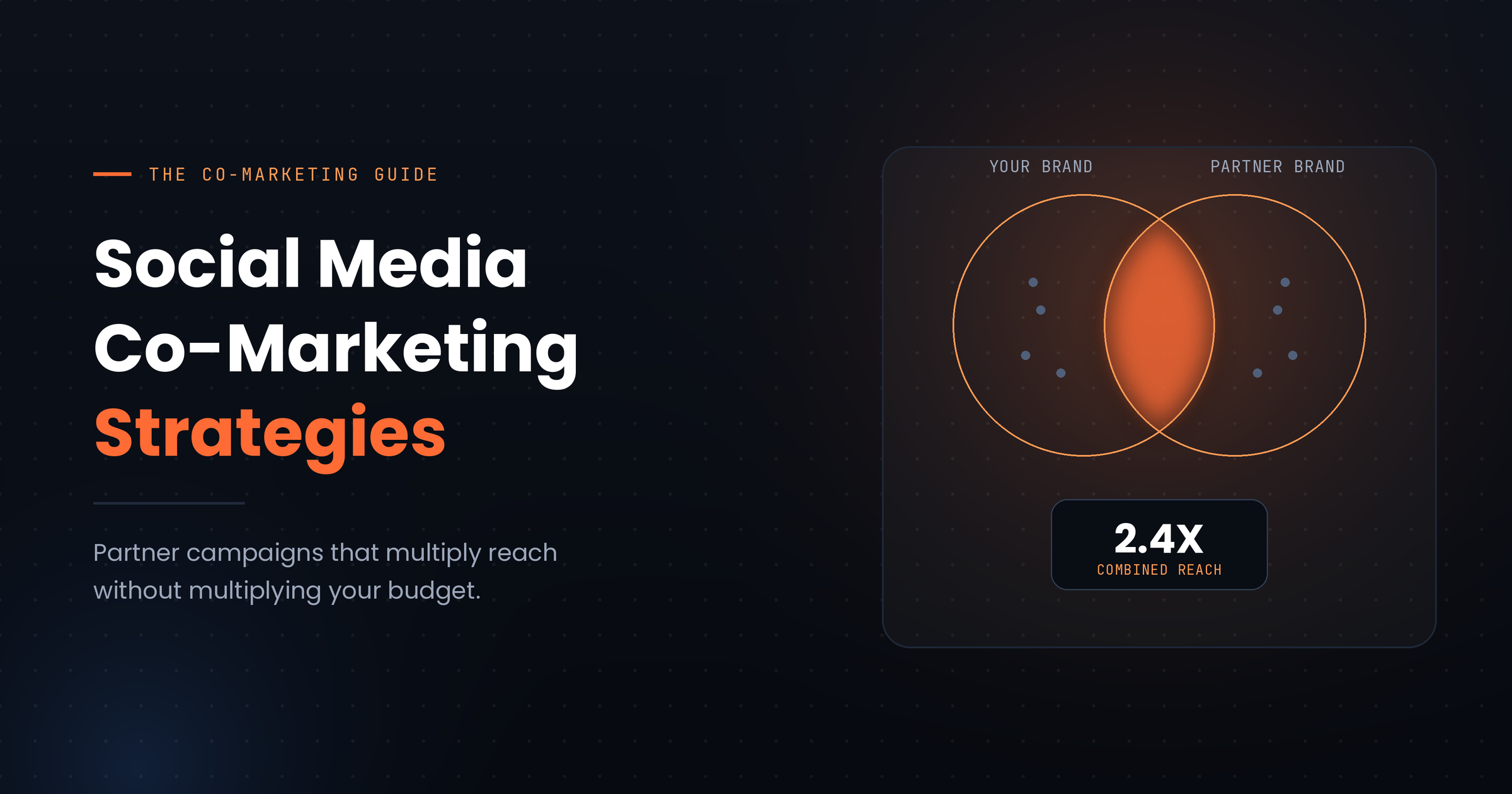
How the brands winning at co-marketing structure creator partnerships and cross-brand collaborations for real ROI — not just reach — backed by current benchmark data.


Co-marketing on social media covers more ground than most brands realize — it spans paid creator partnerships, unpaid cross-brand collaborations, and the joint campaigns that let two audiences discover each other for the price of one piece of content. Done well, it’s one of the most cost-efficient growth levers available: it trades audience access instead of ad spend, and it borrows credibility that no paid placement can buy on its own.
The scale involved is no longer niche. The influencer marketing industry alone is valued north of $32 billion, and the large majority of US marketers now run creator partnerships as a standard line item rather than an experiment. Nearly all organizations who use it say it outperforms traditional digital advertising, commonly by two to three times. Yet most brands still run co-marketing the same way they ran it five years ago — single-post shoutouts, one-off collaborations, vague goals — while the brands actually compounding results have quietly changed how they select partners, structure deals, and measure success.
What follows is the set of tactics separating those results. Some apply to creator partnerships, some to brand-to-brand collaborations, and several apply to both — because the underlying discipline is identical: pick the right partner, align on one measurable goal, and build for a relationship rather than a single post.
Co-Marketing & Creator Partnerships, by the Numbers
*Sources: Sprout Social influencer & social media benchmark research, Archive brand-creator ROI study, Aspire.
The Secrets: What the Best Co-Marketing Programs Actually Do
-
Fit beats fame, every time
Nano and micro-creators consistently outperform celebrity partnerships on both engagement and cost. Nano-influencers achieve materially higher engagement rates while costing 20–30% less than macro-influencers — the audience relevance matters more than follower count. The same logic applies to brand-to-brand deals: an overlapping, aligned audience beats a bigger but mismatched one.
-
Build for the relationship, not the single post
Always-on creator programs outperform one-off campaigns by a wide margin — long-term relationships generate roughly 70% higher engagement, and most creators explicitly prefer ongoing partnerships, often discounting rates in exchange for continuity. A brand that treats a collaboration as a single transaction is leaving both performance and negotiating leverage on the table.
-
Match the platform to the collaboration type
Engagement rates for the same creator tier vary enormously by platform — nano-influencers see dramatically higher engagement on TikTok than on Instagram, for instance. Don’t run identical co-marketing creative across every platform; structure the partnership around where that specific audience actually engages, not where your brand happens to already post.
-
Amplify the best organic content with paid spend
Creator content that’s boosted through paid social meaningfully outperforms brand-made ads and organic posts alone — some formats see conversion rates several times higher once amplified. Treat your top-performing collaboration content as a paid-media asset, not a one-and-done organic post.
-
Set one KPI per campaign — not five
The most common mistake in cross-promotion is skipping clear goal-setting before launch. Pick a single primary metric — new subscribers, foot traffic, or direct sales — because trying to measure everything at once produces data nobody can act on, and it makes partner selection and creative decisions far harder to make well.
-
Actually measure it — most brands still don’t
Despite proven returns, a meaningful share of brands still don’t rigorously track co-marketing or influencer ROI. That gap is a real opportunity: teams that implement proper attribution and reporting are working with better information than most of their category, which compounds into smarter partner and budget decisions over time.
-
Choose complementary, non-competing partners
The strongest brand-to-brand collaborations pair companies that share an audience but don’t compete directly — a software company and a coworking space, for example, rather than two direct rivals. This keeps both parties motivated to promote the partnership fully instead of protecting territory.
-
Design co-branded creative that looks native to both audiences
Tone, voice, and visual style need to genuinely match both brands, not just slap two logos on one asset. When the collaboration feels forced or purely promotional, performance suffers — audiences can tell the difference between authentic collaboration and a paid tag.
-
Use joint giveaways to grow both lists at once
A giveaway that requires entrants to follow or subscribe to both partners is one of the most reliable co-marketing tactics for list and audience growth, because it converts one act of engagement into two owned assets simultaneously — email subscribers or followers for each brand.
-
Let a customer be your co-marketer
For B2B brands especially, publicly highlighting a customer’s team or work on social media is an underused form of co-marketing — it flatters the customer, deepens the relationship, and shows prospects exactly what working with you looks like, all without a formal partnership agreement.
-
Check brand safety before the deal, not after
The quality and tone of a potential partner’s existing content directly affects how a collaboration will land — most creators say a brand’s own content quality shapes their willingness to work together, and the reverse is equally true. Vet a partner’s recent content and audience sentiment before you sign, not after a post underperforms.
-
Don’t let AI-generated partners replace real relationships
A meaningful share of consumers remain uncomfortable with brands using AI-generated influencers or synthetic creator content. AI tools are genuinely useful for speed and efficiency in campaign production, but the trust that makes co-marketing work is still built on a real, credible relationship — human or brand-to-brand.
-
Extend co-marketing beyond the feed
The best programs don’t stop at a shared social post. Co-hosted webinars, joint email sends, and even offline touches multiply a single partnership across more channels than social media alone. For B2B partnerships in particular, a coordinated direct mail marketing strategy aimed at a shared target account list can reinforce a digital co-marketing push in a way that cuts through inbox and feed fatigue — most competitors never think to extend a social partnership offline at all.
-
Treat B2B co-marketing as a campaign, not a favor
A single co-branded LinkedIn post rarely moves a buying committee on its own. The partnerships that actually generate pipeline are built into a broader, sequenced program — reaching different stakeholders with different content at different stages — which is exactly the kind of structure covered in our guide to B2B marketing campaign strategies. Co-marketing works best as one channel inside that larger system, not as a standalone tactic.
-
Bring legal and partnerships in early, not at signature
Miscommunication and unclear expectations are among the most common reasons collaborations underperform or sour. Looping in whoever owns budgeting, contracts, and task allocation before creative work begins — not after — prevents the back-and-forth that quietly kills momentum on a joint campaign.
Platform Performance Snapshot for Creator Co-Marketing
Platform choice changes the math on almost every co-marketing decision — budget, creator tier, and even campaign format should follow this data rather than habit.
| Platform | Brand partnership share | Notable strength |
|---|---|---|
| 57–72% | Default platform; highest overall brand adoption | |
| TikTok | 52–69% | Highest nano-influencer engagement; fastest-growing spend |
| YouTube | 37% | Longest-lasting recall — 62% remember mentions after 30 days |
The takeaway isn’t “pick one.” It’s that Instagram, TikTok, and YouTube each reward a different kind of co-marketing content — quick visual collaboration, high-engagement short-form, and durable brand recall, respectively — so a multi-platform program outperforms a single-channel one for most brands.
Get More Co-Marketing & Partnership Playbooks
Join thousands of marketing leaders getting our weekly playbook — partnership frameworks, creator benchmarks, and campaign teardowns — straight to your inbox.
Mistakes That Quietly Sink Co-Marketing Campaigns
- Chasing follower count over audience fit, then wondering why engagement disappoints
- Treating every collaboration as a single post instead of a relationship worth investing in
- Running the same creative across every platform instead of matching format to audience behavior
- Setting no primary KPI, so success becomes a matter of opinion after the fact
- Skipping ROI tracking entirely and judging campaigns on vibes or vanity engagement
- Partnering with a direct competitor instead of a complementary, non-competing brand
- Rushing to signature without looping in legal or partnerships early enough
- Confining a partnership to social media when email, events, or direct mail could extend its reach
Co-marketing isn’t a discount version of paid advertising. It’s a trade in audience trust — and trust compounds when a partnership is built to last, not spent all at once on a single post.
Final Thoughts
The brands getting real ROI from social media co-marketing aren’t necessarily spending more — they’re being more deliberate. They pick partners for genuine audience fit over reach, they build ongoing relationships instead of one-off posts, they amplify what works with paid spend, and they actually measure whether any of it moved a real business metric. Most of that is discipline, not budget.
The other pattern worth internalizing is how far the best programs extend beyond a single social post. Co-marketing that stops at a shared Instagram Reel is leaving reach on the table that a joint webinar, a shared email send, or even an offline touch could capture. Treat co-marketing as one coordinated channel inside a broader campaign system, not an isolated tactic run by whoever manages the social calendar.
Start with the secrets that expose your biggest current gap — partner fit, KPI clarity, or measurement — fix that first, and layer in the rest as the relationship proves itself. Co-marketing rewards patience and specificity far more than it rewards the biggest partner logo you can find.
Frequently Asked Questions
Build Partnerships That Move Pipeline
Get a free growth audit from TwoFold USA — and a co-marketing plan built around measurable ROI, not just reach.
Get Free Growth Audit