Cold Outreach Strategies Beyond LinkedIn and Email in 2026
Video prospecting, direct mail, gifting, cold calling, and signal-based sequences — the response-rate data behind outreach that actually cuts through inbox saturation.


Cold email reply rates have fallen to roughly 3.43% industry-wide, down from around 8.5% in 2019, and the average B2B decision-maker now receives more than 100 sales emails a week. LinkedIn isn’t much of an escape hatch anymore either — daily connection limits cap most accounts around 100 requests a week, and inboxes there are getting just as crowded as email. Meanwhile, the average B2B buying group has grown to roughly 22 stakeholders, meaning even a strong single-channel, single-contact approach is structurally too narrow to reach who actually needs to say yes.
The response is straightforward, if underused: channels beyond the two everyone already saturates. Multi-channel sequences outperform single-channel outreach by 287%, and teams anchoring outreach to real buying signals — rather than cold lists — see reply rates of 15–25%, roughly five to seven times the industry average. The highest-performing teams right now aren’t necessarily better at email or LinkedIn; they’re the ones who’ve built video, direct mail, gifting, and well-timed phone calls into the same coordinated sequence.
This guide covers exactly those channels: the data behind video prospecting, direct mail and dimensional gifting, cold calling in its current form, and signal-based triggering — plus how to sequence them together for a real buying committee rather than a single contact.
Cold Outreach, by the Numbers
*Sources: Smartlead Cold Outreach Guide, Sendspark Video Prospecting Research, Geisheker/ANA-DMA Direct Mail Report, STACK BD Video Prospecting Benchmark, Launch Leads, Martal Sales Statistics.
Video Prospecting: The Highest-Leverage Alternative to Text
Personalized 1:1 video consistently produces the largest single reply-rate lift of any tactic measured against plain-text cold email. Terminus documented a 216% higher response rate on video prospecting versus standard text outreach; ReviewTrackers saw a 92% increase in reply rates after equipping its team with personalized video; and one rep running 400+ personalized prospecting videos achieved a 20% response rate with an 80% open rate and 25% close rate among viewers. Across the board, 93% of revenue leaders using video report positive, measurable results.
The format that works: 45–90 seconds, addresses the prospect by name, references something specific to them, and ends with one clear call to action. The scaling breakthrough is a “record once, personalize at scale” workflow — one high-quality master recording, with AI inserting the prospect’s name, company, and website automatically — cutting per-contact production time from 5–8 minutes down to under 5 seconds while preserving the human-connection effect that drives the reply-rate lift in the first place.
Direct Mail and Dimensional Gifting: Physical Cuts Through Digital Noise
The response-rate gap between physical mail and email is large enough to be genuinely surprising: B2B direct mail averages a 4.4% response rate on cold prospect lists, climbing to 5–9% on house lists of existing customers, and 5–15% on dimensional mailers (boxes, tubes, packages) sent to targeted ABM lists — compared to 0.12–1% for email. That’s roughly a 36x gap. Dimensional mail in particular achieves near-100% open rates, largely because office mailrooms route packages directly to the named recipient rather than screening them the way inboxes filter marketing email.
Gifting platforms extend the same logic in a lighter-touch form: Sendoso reports that 64% of senders saw increased campaign ROI when gifts were targeted at the right accounts and genuinely personalized rather than generic. Direct mail and gifting programs make the most financial sense under specific conditions: average contract values above roughly $50K, named-account ABM targeting rather than broad prospecting, and a sales motion where digital channels are already saturated and relationships genuinely matter to the buying decision.
| Channel | Typical response rate | Best fit |
|---|---|---|
| Email (text-only) | 0.12–1% (cold), 1–5% reply | High-volume, low-cost baseline |
| Personalized video | 200–300% lift over text email | First-touch, ABM priority accounts |
| Direct mail (cold list) | 4.4% | Executive targeting, saturated digital channels |
| Dimensional mail / gifting | 5–15% | Named ABM accounts, deals above ~$50K |
| Cold calling | 6.71% connect, 2.5% meeting conversion | Signal-triggered, not cold lists |
| Signal-based multi-channel | 15–25% | Any channel, anchored to a real buying trigger |
Get the Outbound Playbook
Join thousands of sales and marketing leaders getting our weekly playbook — outreach benchmarks, multi-channel sequencing, and pipeline frameworks — straight to your inbox.
Cold Calling: Still Alive, Just Retargeted
Cold calling hasn’t died — it’s been re-aimed. Cold call connect rates average 6.71%, with top-performing teams reaching 9%, and 13% of connected calls convert into a booked meeting. Timing matters more than most reps assume: calling during the 4–5 PM window delivers 47% higher connect rates than the average time slot. More than half of B2B buyers still say they prefer phone contact as part of the sales process — the channel isn’t rejected, it’s just ineffective when aimed at a cold list instead of a warm signal.
That last point is the real shift: cold calling now works best as a signal-triggered channel rather than a volume play. A call referencing a prospect’s recent funding announcement, a hiring push, or engagement with competitor content converts meaningfully better than a scripted call to a name pulled from a purchased list.
Signal-Based Outreach: The Multiplier Across Every Channel
The single biggest lever across every channel covered so far isn’t which one you pick — it’s whether the message is anchored to a real, timely signal. Teams using signal-based selling see response rates averaging around 18%, compared to the 3.4% industry baseline for cold outreach — better than a fivefold improvement — and trigger-based prospecting acting within 24 hours of a buying signal is six times more likely to result in a live conversation than outreach with no trigger at all. More than 85% of B2B companies using intent data report higher response rates and more successful prospecting overall.
A prospect who just announced a funding round, posted about a hiring challenge, or engaged with a competitor’s content is in a fundamentally different psychological state than a cold name on a list. Arrive at that moment with a relevant message, and you’re not interrupting — you’re on time.
Reaching the Whole Buying Committee, Not One Contact
The average B2B buying group now includes roughly 22 stakeholders, up sharply from the 6–10 estimate most sales teams still plan around — which is exactly why single-threaded outreach to one contact so often stalls even when that person is genuinely interested. Multi-threading a sequence across several contacts at the same account increases response rates by 93% compared to single-contact outreach, provided the messaging is coordinated rather than sent as an uncoordinated blast to everyone at once.
Reaching a real buying committee — not just the first name on a list — requires the same campaign-sequencing discipline covered in our guide to B2B marketing campaign strategies, where mapping the buying group and coordinating touches across roles is treated as foundational rather than an advanced tactic. The channels above only compound in value once they’re aimed at the right group of people, not just the easiest-to-find contact.
Sequencing the Channels Together
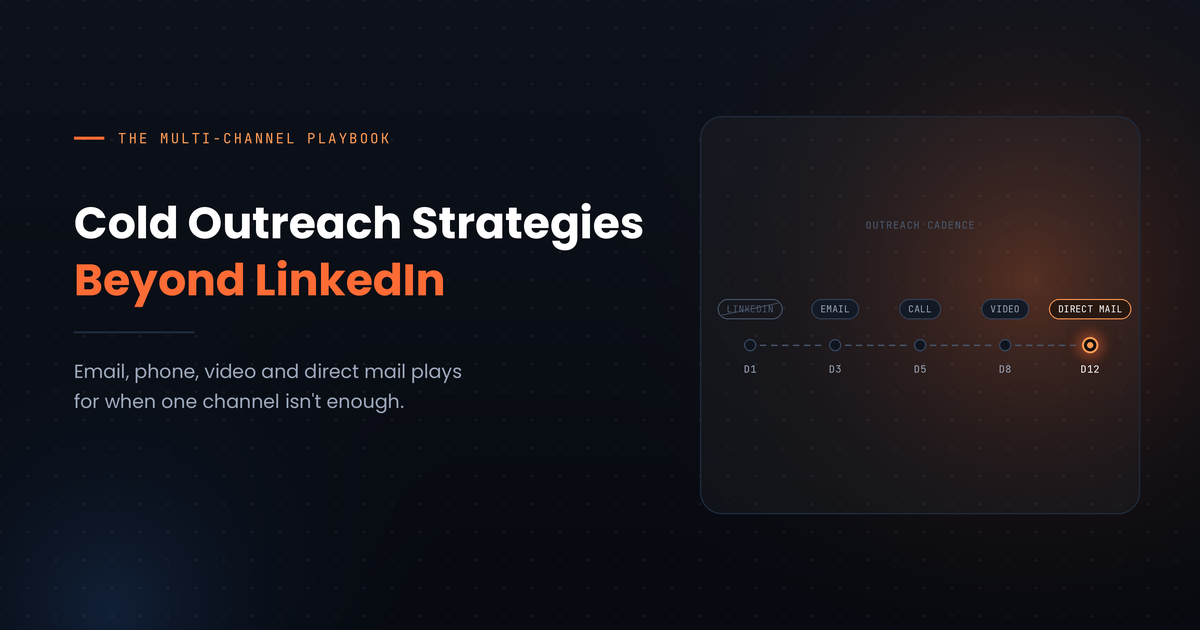
None of the channels above should run in isolation — the data is consistent that coordinated, sequenced contact across multiple channels dramatically outperforms even the best single channel run alone. A well-built sequence runs 4–6 steps (1–3 step sequences consistently underperform), spans 8–12 touchpoints when multiple contacts and channels are combined, and layers channels deliberately: an email for context, a video for a human first touch, a signal-triggered call, and — for genuinely high-value ABM accounts — a piece of direct mail or a personalized gift to break through when digital alone hasn’t landed.
Deciding which channels deserve that investment, and in what order, is really a channel-allocation decision — the same discipline covered in our broader guide to marketing channel strategy, where owned, earned, and paid channels are weighted deliberately rather than chosen out of habit. Cold outreach is a specific application of that same principle: video, mail, and calling all cost more per touch than email, so they should concentrate on the accounts and moments where the higher cost is actually justified by deal size and signal strength.
Text-based channels deserve a place in that mix too, particularly for time-sensitive or event-based outreach where a prospect is more likely to see a message within minutes rather than hours. The same discipline that makes SMS one of the highest-converting channels in consumer marketing — covered in detail in our SMS marketing strategy guide — applies just as directly to B2B outreach: compliant opt-in, genuine relevance, and a message that earns the interruption rather than a blast sent to every phone number a list-building tool could find.
When to Bring in Outside Help
Running video production, dimensional mail logistics, signal-based triggering, and multi-threaded sequencing simultaneously — while keeping every touch coordinated across channels rather than duplicated or contradictory — is a genuine operational lift most in-house teams underestimate until they’re mid-build. For teams without the capacity to run this as a connected system, our overview of digital marketing strategy consulting services in USA markets is a useful starting point for evaluating outside support built for exactly this kind of coordinated, multi-channel execution.
Mistakes That Undermine Cold Outreach Beyond Email
- Treating video, mail, or gifting as one-off tactics instead of steps in a coordinated sequence
- Sending dimensional mail or gifts to a broad list instead of named, high-value ABM accounts
- Cold calling from a purchased list with no signal or trigger behind the call
- Single-threading outreach to one contact when the real buying group includes 22 stakeholders
- Uncoordinated multi-contact outreach that reads as a spam blast rather than a deliberate sequence
- Sequences shorter than four steps, when 4–6 steps consistently outperform 1–3
- Generic video “personalization” limited to a name insert, with no real signal or context referenced
- No opt-out or compliance process across text, mail, or calling channels
Final Thoughts
LinkedIn and email will keep their place in any outreach program — they’re cheap, scalable, and still the right starting point for most sequences. But the data is consistent about where the outsized returns actually sit right now: personalized video delivering 200–300% reply-rate lifts, direct mail and dimensional gifting achieving response rates 5 to 15 times higher than email, and signal-anchored outreach across any channel outperforming cold lists by five to seven times.
None of these channels work as a silver bullet on their own — the 287% advantage of multi-channel over single-channel sequencing is the real headline here. The highest-performing teams aren’t choosing video instead of email, or mail instead of calling; they’re sequencing all of it deliberately, aimed at a real buying committee rather than a single contact, and triggered by genuine signals rather than a purchased list.
Start where the return is clearest for your deal size: video for broad first-touch personalization at scale, direct mail and gifting reserved for your highest-value named accounts, and signal-based triggering layered across every channel you already run. That combination, more than any single new channel, is what actually cuts through the saturation LinkedIn and email alone can no longer overcome.
Frequently Asked Questions
Build an Outreach Program That Cuts Through
Get a free growth audit from TwoFold USA — and a multi-channel outreach sequence built around real buying signals, not another cold email blast.
Get Free Growth Audit