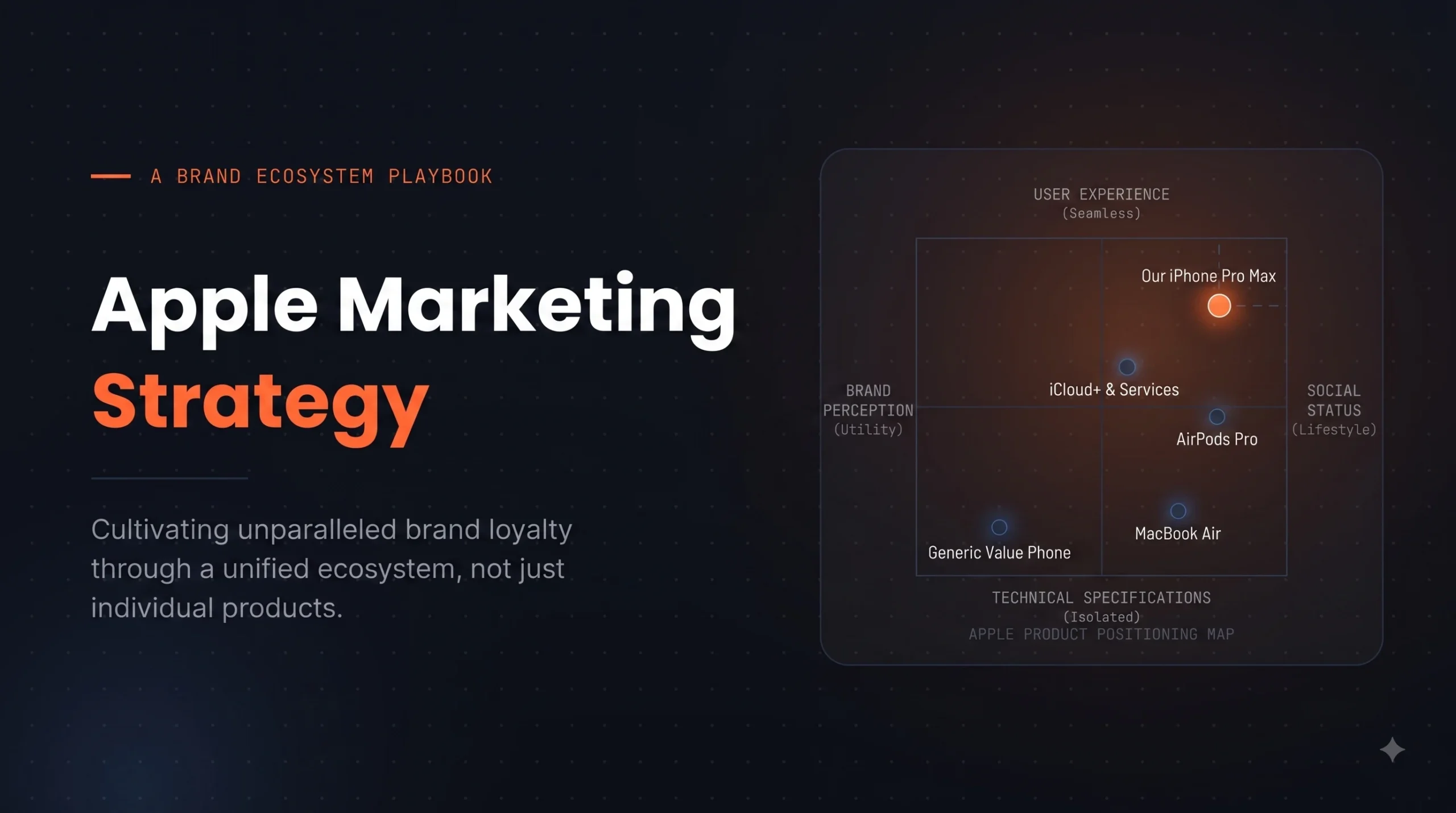
Apple Marketing Strategy Case Study: Data, Stats & Full Breakdown
The five strategic pillars, iconic campaigns, retail and services flywheel data, and the numbers behind the world’s most valuable brand.


Apple closed its December 2025 quarter (fiscal Q1 2026) with $143.8 billion in revenue — up 16% year over year and the best quarter in the company’s history — driven by the iPhone 17 lineup and an installed base that has now crossed 2.5 billion active devices. That single data point captures what makes Apple’s marketing genuinely worth studying: a company that rarely discounts, almost never lists a spec sheet in its hero creative, and still commands some of the highest prices and highest loyalty in consumer technology.
Apple’s brand is valued between $470.9 billion (Interbrand) and $947.1 billion (BrandZ) depending on the ranking methodology used — a wide range that itself says something about how differently brand value gets measured, but both figures place Apple at or near the very top of every major global ranking. Fiscal 2025 revenue reached a record $416.2 billion, and Services — the highest-margin, most marketing-dependent part of the business — has become a genuine second growth engine layered on top of hardware.
This case study breaks down exactly how that’s built: the five strategic pillars behind Apple’s marketing, a listicle of its most iconic campaigns with the context and data behind each, the retail and services numbers that make the “ecosystem flywheel” concrete rather than a buzzword, and the risks and lessons other brands can actually take from it.
Apple, by the Numbers
*Sources: Apple Newsroom investor reporting, BrandVM, RankRed, BusinessModelAnalyst, MatrixBCG, Brandchannel.com.
The Five Pillars of Apple’s Marketing Strategy
Every Apple campaign, retail decision, and product launch traces back to the same five reinforcing pillars — none of them work in isolation.
-
1. Aspirational branding
Apple sells identity and status, not specifications. Marketing rarely mentions megapixels or chip names in hero creative — it shows the photo, the moment, the feeling, and lets the product imply the technology behind it.
-
2. Premium price-skimming
New products launch at the top of the market and rarely discount. A strict Minimum Advertised Price policy prevents retailers from undercutting Apple, protecting brand perception and margin simultaneously — supporting that industry-leading 46.22% gross margin.
-
3. Emotion-driven creative
Campaigns center on human stories and outcomes rather than product features — a photo taken, a life made easier, a promise about privacy — turning a technical decision into an emotional one.
-
4. Experiential retail
Apple Stores function as advertising you can walk into: open layouts, hands-on tables, the Genius Bar, and free “Today at Apple” sessions convert foot traffic into brand immersion, not just transactions.
-
5. The services flywheel
Hardware, software, and services reinforce each other continuously — each new device raises switching costs and lifetime value, and services revenue (Apple Music, iCloud+, Apple TV+, Apple One) compounds on top of an already-massive installed base.
Financial Snapshot: How the Strategy Shows Up in the Numbers
Marketing strategy is easy to describe in the abstract; Apple’s is unusually easy to verify against hard financial data.
| Metric | Figure | Context |
|---|---|---|
| Fiscal 2025 revenue | $416.2B | Company record |
| Fiscal Q1 2026 revenue | $143.8B (+16% YoY) | Best quarter in company history; iPhone 17-driven |
| Fiscal 2024 revenue | $391B | iPhone ≈ 50% of total revenue |
| FY2024 services revenue | $96.17B | Apple Music, iCloud+, Apple TV+, Apple One |
| Q3 FY2025 revenue | $94.0B (+10% YoY) | Services hit an all-time quarterly high |
| Direct-channel revenue share | ~30% | Retail stores + online, vs. carrier/reseller channels |
| Brand value (BrandZ) | $947.1B | World’s most valuable brand by this ranking |
| Brand value (Interbrand) | $470.9B | Different methodology, still #1 globally |
Services revenue growth (illustrative)
*Rounded figures compiled from Apple’s fiscal reporting; FY2025 continued to set new quarterly services records without a confirmed final annual figure at time of writing.
Apple’s Most Iconic Campaigns: A Listicle
Seven campaigns that shaped how the world thinks about Apple’s marketing — and the strategic pillar each one demonstrates.
1. “1984” — Super Bowl
The Macintosh launch ad, widely regarded as one of the most influential television commercials ever made. Positioned Apple as the rebel breaking from conformity — the template for aspirational branding ever since.
2. “Think Different” — 1997
Reintroduced Apple’s identity around creativity and nonconformity rather than product features, tying the brand to cultural icons instead of specifications.
3. “Get a Mac” — 2006–2009
The “I’m a Mac, I’m a PC” campaign used simple, human characters to make an emotional, personality-driven case against Windows — comparative advertising without ever naming Microsoft directly.
4. “Shot on iPhone” — 2015–present
Turns customers into the campaign. User-submitted photography generates a continuous stream of authentic content at near-zero incremental media cost, while proving the camera’s quality better than any spec sheet could.
5. “Privacy. That’s iPhone.” — ongoing
Translates a technical setting into a human promise, turning privacy into a differentiator and a purchase driver rather than a footnote in the settings menu.
6. Apple Intelligence & Private Cloud Compute — 2024–2026
Made the privacy story concrete for the AI era — positioning on-device and private cloud processing as the trustworthy alternative to competitors’ cloud-first AI approaches.
7. Sunday Night Soccer sponsorship — 2026
A weekly broadcast ritual that places the Apple brand inside a recurring cultural moment rather than a one-off campaign, extending the “experience over ad” philosophy into live sports.
Apple almost never lists specifications in its hero creative. It shows you the photo, not the megapixels — the technology is implied, the outcome is sold.
Get More Brand Strategy Case Studies
Join thousands of marketing leaders getting our weekly playbook — brand positioning breakdowns, campaign analysis, and channel benchmarks — straight to your inbox.
Retail as Marketing: The Numbers Behind the Experience
Apple Stores aren’t a distribution afterthought — they’re core marketing infrastructure, and the figures back that up directly.
| Retail metric | Figure |
|---|---|
| Retail store count | 500+ stores across 15 countries |
| Flagship store weekly visitors | 25,000+ |
| Direct-channel revenue share | ~30% of total revenue |
| In-store programs | Genius Bar, Today at Apple, Shop with a Specialist over Video |
Store reopenings and remodels are treated as local news events rather than facilities updates, “Today at Apple” sessions turn footfall into free skills education, and “Shop with a Specialist over Video” extends the same concierge retail experience to customers who never set foot in a physical store — removing friction while preserving the premium, high-touch feel that discount retail can’t replicate.
The Ecosystem Flywheel, in Practice
“Ecosystem” is one of the most overused words in tech marketing, but Apple’s version is unusually concrete: buy an iPhone, and iMessage, AirDrop, and Handoff quietly raise the cost of ever switching away. Add Apple One — bundling Apple Music, iCloud+, Apple TV+, and Apple Fitness+ into a single household bill — and the services layer becomes a second growth engine that compounds on top of the hardware base rather than competing with it for budget or attention.
The strategic logic is self-reinforcing: more devices sold means a larger base for services to monetize; higher services engagement means stickier hardware customers who are less price-sensitive at the next upgrade cycle. Fiscal Q3 2025’s revenue record, with services hitting an all-time high in the same quarter, is a direct illustration of that flywheel actually turning rather than a marketing slogan.
Risks and Open Questions
No case study this consistently successful is without genuine strategic risk. A premium brand built on being ahead of the category cannot afford to look like it’s playing catch-up — which is exactly what makes Apple’s AI positioning the single most closely watched marketing variable heading into the next several product cycles. Competitors moving faster and louder on generative AI features put real pressure on a brand whose entire pitch depends on always seeming to lead, not follow.
The premium pricing strategy that protects margin also caps addressable market in price-sensitive regions — exactly the markets where competitors like Samsung, with a much broader price-tier portfolio, capture volume Apple’s model isn’t built to chase. For a fuller picture of how that plays out competitively, our Apple vs Samsung marketing strategy comparison covers the head-to-head positioning, ad spend, and fifteen-year market share history between the two companies in detail.
What Other Brands Can Take From This
- Sell the outcome, not the spec. Hero creative that shows what a product does for someone consistently outperforms creative that lists what a product technically is.
- Let customers become the campaign. “Shot on iPhone” proves user-generated content can out-scale paid media at a fraction of the cost, provided the product genuinely earns it.
- Treat retail as a brand channel, not just a sales channel. Every touchpoint — store layout, staff training, post-purchase support — is a marketing decision, whether or not it’s labeled as one.
- Build the flywheel deliberately. A services or subscription layer only compounds if it’s designed from the start to reinforce the core product, not bolted on afterward.
Final Thoughts
Apple’s marketing strategy holds together because every pillar reinforces every other one: aspirational creative justifies premium pricing, premium pricing funds an unmatched retail experience, retail experience deepens ecosystem lock-in, and ecosystem lock-in fuels a services flywheel that keeps compounding on top of a 2.5-billion-device installed base. None of the five pillars would work nearly as well in isolation — the discipline is in never letting any one of them drift out of alignment with the others.
The financial results are the clearest evidence the strategy works: a $416.2 billion fiscal-2025 revenue record, a best-ever quarter to open fiscal 2026, and a brand value that sits at or near the top of every major global ranking regardless of methodology. The open question isn’t whether the model works — it’s whether it can keep working as AI reshapes what “leading the category” means for the first time in over a decade.
For any brand studying this case, the transferable lesson isn’t “be like Apple” — it’s “be this consistent.” Every pillar, every campaign, and every retail decision points in the same direction, sustained over decades rather than reinvented every product cycle. That kind of discipline, more than any single ad, is what actually built the world’s most valuable brand.
Frequently Asked Questions
Build a Brand Strategy This Consistent
Get a free growth audit from TwoFold USA — and a positioning strategy built on the same reinforcing discipline behind the world’s most valuable brand.
Get Free Growth Audit