iPhone Marketing Strategy: The Masterclass in Premium Positioning (2026)
How Apple doesn’t just sell a smartphone—it sells a lifestyle, an ecosystem, and an identity. A complete breakdown of the strategy driving the world’s most profitable device.


The iPhone is not just a product; it is the financial and cultural sun around which the entire Apple ecosystem orbits. In 2026, the iPhone continues to account for roughly 52% of Apple’s massive annual revenue. But more importantly, it serves as the master key. It is the device that locks users into Apple Music, Apple Watch, AirPods, and Apple Intelligence. To understand how they achieve this unprecedented retention, you have to look beyond the specs.
Apple marketing has never been about megahertz, RAM, or battery capacities. It is fundamentally about human emotion, privacy, creativity, and status. While understanding the overall Apple marketing strategy gives you the macro view of the trillion-dollar company, examining the iPhone specifically reveals the tactical genius of how they execute product-led growth at a global scale.
This deep dive breaks down the five core pillars of the 2026 iPhone marketing strategy: the premium scarcity model, the evolution of “Shot on iPhone,” the monetization of privacy through Apple Intelligence, the services flywheel, and the theater of retail.
The iPhone Economy (2026 Snapshots)
1. The “Pro” Tier and Premium Positioning
Apple fundamentally rejects the race to the bottom. While competitors flood the market with low-margin, high-volume devices across every conceivable price tier, Apple maintains strict price integrity. You cannot buy a “cheap” new iPhone; you can only buy an older model that has slid down the pricing matrix (like the iPhone 14 or iPhone SE).
To see how this contrasts with their biggest rival’s approach to market segmentation and price tiering, read our full breakdown of the Apple vs Samsung marketing strategy. Where Samsung uses the Galaxy A-series to capture budget buyers, Apple uses the “Pro” and “Pro Max” models to continuously push the ceiling of what consumers are willing to pay.
The Decoy Effect in Action
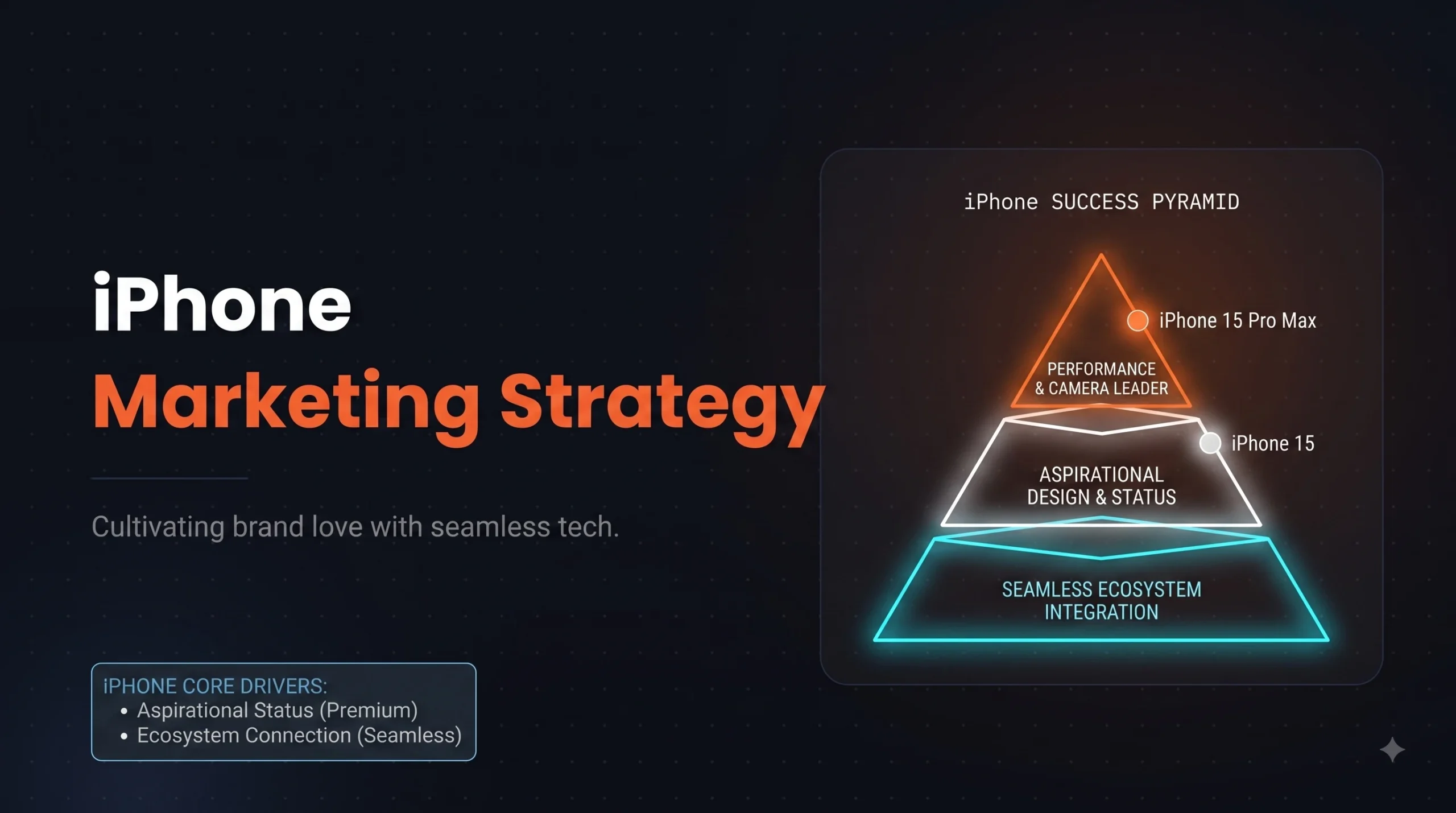
Apple’s 3-tier pricing strategy (Base, Pro, Pro Max) is a masterclass in behavioral economics. The standard iPhone exists primarily to make the “Pro” version look like a better value. For an extra $200, the consumer rationalizes that they are getting a superior camera system, titanium build, and advanced AI chips—up-selling millions of users into higher-margin devices.
2. “Shot on iPhone”: The Ultimate UGC Campaign
First launched in 2015, “Shot on iPhone” remains one of the longest-running and most successful marketing campaigns in history. It completely shifted the paradigm of tech advertising from “Look at what this phone has” (megapixels, sensors) to “Look at what you can do with this phone.”
By 2026, the campaign has evolved from billboard user-generated content (UGC) to full-blown Hollywood production. Apple now routinely shoots its entire 45-minute Keynote presentations, as well as mainstream music videos for artists like Olivia Rodrigo and The Weeknd, entirely on the iPhone Pro Max. This strategy perfectly targets the “Creator Economy.”
| Era | Campaign Focus | Psychological Trigger |
|---|---|---|
| 2015 – 2018 | UGC Billboards (Everyday users taking beautiful photos) | Accessibility: “I can be an artist too.” |
| 2019 – 2022 | Cinematic Mode & Short Films by Indie Directors | Aspiration: “This is a professional filmmaking tool.” |
| 2023 – 2026 | Apple Keynotes & Blockbuster Music Videos shot on iPhone | Authority: “This replaces a $50k cinema camera.” |
3. Privacy and Apple Intelligence
For years, Apple’s marketing slogan was simple: “What happens on your iPhone, stays on your iPhone.” They weaponized privacy, turning a compliance issue into a massive competitive advantage against data-hungry competitors like Google and Meta.
With the full rollout of Apple Intelligence in the iPhone 16 and 17 cycles, this marketing narrative shifted into overdrive. While competitors route AI queries to massive cloud servers, Apple markets on-device processing. They aren’t just selling a smarter Siri; they are selling peace of mind. The marketing message is incredibly potent: AI that knows you, but doesn’t expose you.
Privacy isn’t a feature of the iPhone; it is the foundation of the brand trust that justifies the premium price tag. In an era of AI anxiety, Apple is selling digital sanctuary.
4. The Ecosystem Flywheel (Services)
The iPhone marketing strategy does not end at the point of sale; the hardware is merely the trojan horse for Services. As of 2026, Apple’s Services division (Apple Music, iCloud+, Apple TV+, Apple Arcade) generates over $90 billion annually.
The marketing genius here is seamless integration. The iPhone alerts you when your iCloud storage is full (a frictionless $2.99/mo upsell). Purchasing a new iPhone gives you 3 free months of Apple TV+. The iPhone connects magically to the Apple Watch, making it harder to ever switch to an Android device. Apple markets the magic of the ecosystem, knowing that once a user owns three Apple devices, their churn rate drops to nearly zero.
Deconstruct the World’s Best Brands
Join 15,000+ marketing leaders who receive our weekly breakdown of product positioning, pricing psychology, and brand strategy.
5. Retail as Marketing Theater
Finally, we cannot discuss iPhone marketing without discussing the Apple Store. Apple treats its physical retail locations not merely as distribution channels, but as experiential marketing hubs. Angela Ahrendts (former SVP of Retail) famously referred to Apple Stores as “Town Squares.”
Through programs like “Today at Apple,” users are invited to free sessions to learn photography, coding, or music production on their iPhones. This accomplishes two things:
- It demystifies the technology, increasing product usage and customer satisfaction.
- It builds community loyalty, transforming a transactional retail space into a brand temple.
The Core Takeaway
The iPhone marketing strategy succeeds because it is entirely integrated. The sleek industrial design, the minimalist ad copy, the glass-and-steel retail stores, and the premium pricing model all tell the exact same story. Apple never discounts the iPhone, because discounting destroys the illusion of luxury. They don’t talk about RAM, because tech specs invite commoditization.
Instead, Apple markets what the iPhone allows you to become: a better photographer, a more private citizen, a more connected friend, and part of an exclusive, premium club. It is the ultimate lesson in selling the transformation, not the tool.
Frequently Asked Questions
Price: Premium skimming strategy; higher margins, rarely discounted.
Place: Exclusive Apple Stores, premium authorized resellers, direct-to-consumer online.
Promotion: Emotional storytelling, “Shot on iPhone” UGC, highly stylized product unveilings (Keynotes).
Apply Premium Positioning to Your Brand
Get a free growth audit from TwoFold USA. Learn how to increase your margins, build ecosystem lock-in, and improve your brand perception.
Get Free Growth Audit